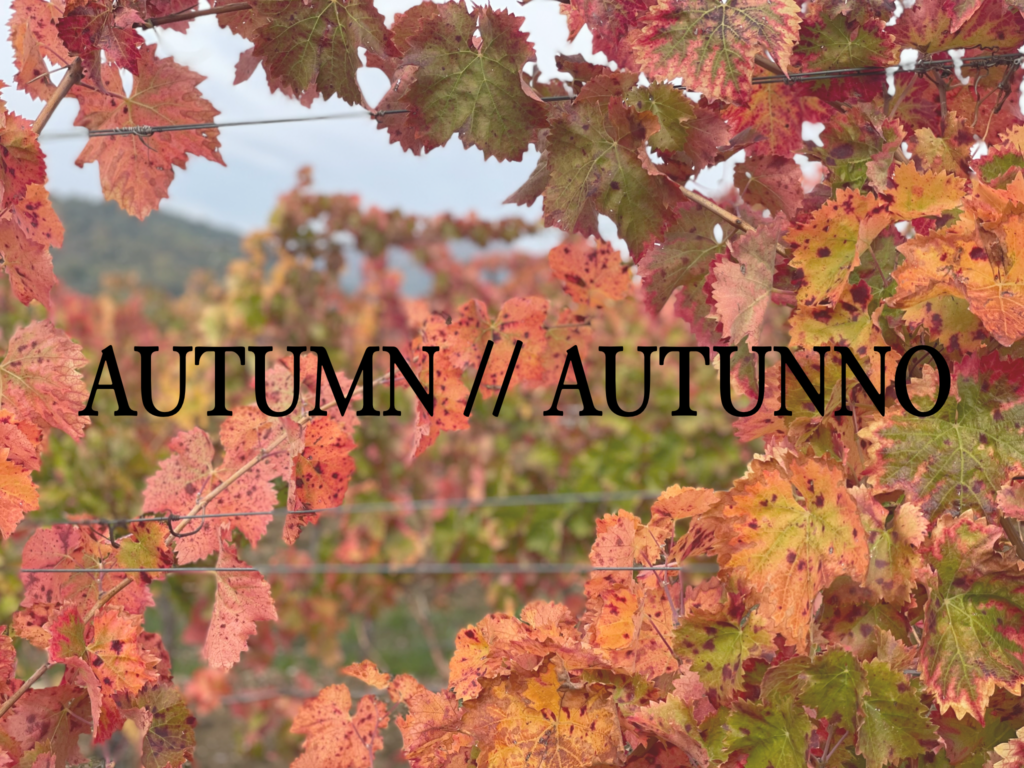
This is part of a series inspired by Vivaldi’s Four Seasons and curated by Scott Noriega. You can listen to the playlist by clicking the button above and read on for Scott’s insightful notes on the pieces. My wine pairing suggestion for the Autumn Playlist is a Langhe Nebbiolo from Piemonte. While typically light in color, these are wines with structure and offer equal parts tart red fruit and a warm earthiness. Perfect for autumnal vegetable dishes, hearty soups, mushroom risotto…
By Scott Noriega
Scott is a pianist, writer and music teacher from Queens, NY where he currently resides. Having run the academic gamut of degrees – from Bachelors to Masters and finally PhD – he is currently living his life a bit more: writing poetry, searching out pianistic repertoire, baking pastries, composing new music, and traveling, all while exploring the world of cocktails, history and music weekly on Instagram @telling_cocktails.
Antonio Vivaldi
(1678, Venice – 1741, Vienna)
Violin Concerto in F Major
Vivaldi’s L’autunno or Autumn Concerto from his celebrated Le quattro stagioni (The Four Seasons) is boisterous, lively, animated, and joyful – even in those moments of calm repose, we sense a feeling of satisfaction and revelry as all of the hard work of the summer, along with its extreme heat and powerful storms, has ended. Now is a time for the harvest celebrations to begin. Vivaldi musically depicts not only these wine-infused village parties here, but the aftermath of those long drinking nights, ones followed often by a late-morning rising. By the beginning of the third movement, he has depicted yet another topic of autumn: the hunting season has begun.
Allegro
Celebra il Vilanel con balli e Canti
Del felice raccolto il bel piacere
E del liquor de Bacco accesi tanti
Finiscono col Sonno il lor godere
Adagio molto
Fà ch’ ogn’ uno tralasci e balli e canti
L’ aria che temperata dà piacere,
E la Staggion ch’ invita tanti e tanti
D’ un dolcissimo Sonno al bel godere.
Allegro
I cacciator alla nov’ alba à caccia
Con corni, Schioppi, e canni escono fuore
Fugge la belua, e Seguono la traccia;
Già Sbigottita, e lassa al gran rumore
De’ Schioppi e canni, ferita minaccia
Languida di fuggir, mà oppressa muore.
Lively
The villagers celebrate with song and dance
The sweet bounty of the harvest,
And set aflame with Bacchus’s wine,
They end their revelry in deep slumber.
Very Slowly
The singing and dancing die away
Amidst the delightful cooling breezes,
Autumn invites all to enjoy
The blissfulness of sleep.
Lively
At dawn, the hunters set out for the chase
With horns, muskets, and hounds.
They follow the trails as the prey flees.
Terrified by the loud clamor of dogs and guns,
And now wounded, it struggles to flee,
But hurt and overcome, it dies.
Domenico Scarlatti
(1685, Naples – 1757, Madrid)
Sonata in C Major, K. 159
Scarlatti’s little C-Major Sonata is the perfect piece to follow Vivaldi’s joyful concerto as the feeling of this work is as jubilant as the former. Though not named by Scarlatti himself, the work later picked up the nickname of La Caccia or The Hunt Sonata for, what I assume, is its
horn-like fanfares, its fast pace, urgency, and the feeling of joy it exhibits. When the composer wrote of his sonatas that one should “seek not profundity in these compositions but rather artistic ingenuity and delight with the object of exercising freedom on the gravicembalo” I think he sells himself short. Not only are these profoundly human works, they are also as delightful for the listener as for the keyboardist – as one can hear in these two performances, the first, on the harpsichord, the second, on piano.
Ottorino Respighi
(1879, Bologna – 1936, Rome)
Poema autunalle
Respighi’s lush and meditative Autumn Poem was described by the composer in just a few words: “A sweet melancholy pervades the poet’s feelings, but a joyful vintner’s song and the rhythm of a Dionysian dance disturb his reverie. Fauns and bacchantes disperse at the appearance of Pan, who walks alone through the fields under a gentle rain of golden leaves.” The musical poem creates a sense of nostalgia – a slowing of pace, a sense of regret, perhaps, but also one of renewed vigor and determination as the tempo increases and the harmonies lighten. As the music quietly fades away, as do the summer months, we are left – like the violin protagonist – alone to ponder our thoughts and feelings of times past.
Gaetano Donizetti
(1797, Bergamo – 1848, Bergamo)
L’elisir d’amore Overture and Bel conforto
L’elisir d’amore is one of Gaetano Donizetti’s greatest comic operas. The story centers on the lovesick and naïve Nemorino, who desperately falls in love with the beautiful farm owner Adina. When Dr. Dulcamara arrives in the village selling a supposed love potion, Nemorino buys it, believing it will make Adina love him – really it’s just a simple Bordeaux. Adina meanwhile agrees to marry the handsome Sergeant Belcore, partly to tease Nemorino, but becomes weary when she sees how sincerely he loves her. She eventually realizes that her true love is Nemorino, breaks off her engagement to Belcore, and the two are happily united.
And the elixir of love? Nemorino unexpectedly inherits money from his uncle – the villagers remain convinced that Dulcamara’s potion was responsible for this happy ending.
The opera is set into motion by a festive orchestral overture followed by a village chorus singing:
Bel conforto al mietitore
Quando il sol più ferve e bolle,
Sotto l’ombra d’un faggio
Riposar dalle fatiche.
A welcome comfort for the reaper,
When the sun burns hot and fierce,
Is to rest after his labors
Beneath the shade of a beech tree.
Gianfrancesco Malipiero
(1882, Venice – 1973, Treviso)
Preludi Autunnali
If autumn is filled with joyful energy for some, for others the season offers a useful metaphor for life: the autumn of one’s life lies near its end and can offer a sense of nostalgia, longing, or time for self reflection.
I cannot say what ran through Malipiero’s mind when composing these works in 1914, but I can imagine: with political strife and the Great War beginning, with Modernism allowing certain artists to break free from the constraints they felt from the previous century, and with the composer reaching middle age with all its doubts and fears, I find these Autumn Preludes – filled with moments of punctuated silences, sparse textures, and unexpected and wandering harmonic progressions – perfect music to accompany one on a brisk autumn walk through the woods, at nighttime on the beach as the waves sing their song, or even in the busy city, though here, in the last mentioned, perhaps best in its most silent hours – those in the wee small hours of the morning.
Giuseppe Mulè
(1885, Termini Imerese – 1951, Rome)
La vendemmia
What other type of composer could write a symphonic poem or symphonic impressions – a musical depiction of a narrative or the feelings that these ideas arouse – about a grape harvest at the end of a long summer than an Italian one, here one born in the northern Sicilian port city of Termini Imerese.
Mulè wrote this work for a festival that took place in Venice in 1936.
Comprising three parts, and lasting a total of around 10 minutes, the first depicts the grape harvesters of Francavilla (di Sicilia, I assume) carrying their overflowing baskets of grapes, as they rush from the vineyard to the wine press. Here the treaders begin stepping on the grapes, the liquids splashing onto their faces and shoulders, staining them red, also dazing and intoxicating them as they work.
The second part sees the priest raising his arm up to thank God, while the villagers voice their jubilation at the abundant harvest.
The final section describes the procession of villagers as they joyfully return to work, the sun slowly setting in the horizon. As night falls, they run to wash themselves under the waters of the fountain as darkness quickly encroaches upon the vineyard and the distant mountains.
Giuseppe Tartini
(1692, Piran – 1770, Padua)
Devil’s Trill Sonata
I can’t help but think of spooky things come the autumn season, even if in Italy, Halloween is only one of the newer traditions – the cooler weather and shortening of daylight certainly help foster these feelings in me.
Tartini’s magnificent Devil’s Trill Sonata is a staple of my own October playlist.
According to Tartini:
“One night, in the year 1713 I dreamed I had made a pact with the devil for my soul. Everything went as I wished: my new servant anticipated my every desire. Among other things, I gave him my violin to see if he could play. How great was my astonishment on hearing a sonata so wonderful and so beautiful, played with such great art and intelligence, as I had never even conceived in my boldest flights of fantasy. I felt enraptured, transported, enchanted: my breath failed me, and I awoke. I immediately grasped my violin in order to retain, in part at least, the impression of my dream. In vain! The music which I at this time composed is indeed the best that I ever wrote, and I still call it the ‘Devil’s Trill,’ but the difference between it and that which so moved me is so great that I would have destroyed my instrument and have said farewell to music forever if it had been possible for me to live without the enjoyment it affords me.”
Whether the sonata is as great as the Devil’s will forever remain a mystery.
What I can say is that whether the work has supernatural origins, it certainly fits the bill for thisautumn-time listener: the dark, melancholic introduction followed by bravura writing, dreamy, hazy sequences, and the final move towards the Devil’s trilling – a trill being the rapid alterationof two neighboring notes, back and forth – always conjure up the mysteries of the season.
Giuseppi Verdi
(1813, Le Roncole -1901, Milan)
Les Vêpres siciliennes, Ballet des quatre saisons: L’autunno
Verdi’s opera, The Sicilian Vespers, includes a ballet titled The Four Seasons – all French Grand Operas performed in Paris would have one.
But rather than a dark and melancholic work, like Tartini’s, Verdi’s ballet music feels light and airy: for me, it depicts not so much the height of autumn’s chilliness, but the end of summer’s warmth, when the days slowly become a bit shorter, and the newfound chill in the air brings with it a welcome relief from the intensity of the previous season.
After its stormy opening, the composer beautifully lightens the mood by use of delicate orchestral textures, including the use of woodwinds, flowing melodies, rustic dance-like rhythms, and a real sense of an Italian autumn: joy and togetherness with just hints of nostalgia.
Mario Castelnuovo-Tedesco
(1895, Florence -1968, Beverly Hills)
Cipressi, op. 17
Cipressi, in English, Cypresses, is an evocative tone poem for solo piano composed in 1920. Castelnuovo-Tedesco composed the piece while holidaying at Villa Forti, an estate near the Tuscan village of Usigliano di Lari, and dedicated it to his wife, adding the descriptive subtitle ricordando i cipressi d’Usigliano di Lari – remembering the Cypresses of Usigliano di Lari.
He was inspired by the stately, slender, and dark cypress trees that dominate the Tuscan landscape – as they do parts of California – as he sought to capture their beauty, physical majesty, and the deep, centuries-old aura of mystery and melancholy often associated with them in Italian culture: these trees are representative not only of death and mourning, as they were for the ancient Greeks, when planted in or near cemeteries, but also eternity, immortality, spiritual elevation when they’re planted in areas of countryside – they bring joy.
Perhaps I chose the piece because I love it, but if that description is not representative of the autumn season, then what is?
Luigi Boccherini
(1743, Lucca – 1805, Madrid)
String Quintet in C Minor, op. 45 no. 1
Luigi Boccherini is today best remembered for his charming A-Major Minuet from the E-Major String Quintet, op. 11 no. 5. It is a fantastic little work – like a breath of fresh air.
But he wrote far more than this little 4 minute work: around 140 string quintets (he was a fabulous cellist, himself), 100 string quartets, 50 trios and duets, 30 symphonies, a dozen each of cello concertos and guitar quintets, and a whole host of vocal music.
This dramatic work was written in 1792 while the composer was living in Spain. The opening Adagio non tanto creates a sense of tension, even exhaustion for me, like a day of hard toil is finally wrapping up. The following Allegro assai brings a spookiness at its opening, one which lightens up in its joyous middle section. The third movement’s Tempo di minuetto feels more like a rustic country-inspired dance than one of the ballroom due in no small part to its opening drone and its overall laid-back character. The stormy Presto finale is driven – one can almost hear the strumming of guitars: Spanish or Italian ones? – in the most impassioned moments here.
Antonio Bazzini
(1818, Brescia – 1897, Milan)
La ronde des lutins, Scherzo fantastique, op. 25
To end our autumnal musical journey, what better piece can we listen to as an encore than Antonio Bazzini’s thrilling five-minute tour de force, his whimsical Round of the Goblins?
This phantasmagorical work uses a number of violin techniques that one can hear throughout: left-hand pizzicato (the sharp plucking of strings), spiccato (the bouncing of the bow on the strings that create the sense of the rapid movements of these little devils), double-stops (the playing of two notes at the same time, creating two ‘voices’), harmonics (the eerie super high almost glassy or flute-like notes that seem otherworldly), along with rapid scale patterns, arpeggios that go up and down the violin’s range, and double-note trills.
Are these simply mischievous goblins rather than evil ones?
But don’t worry – all ends happily enough: the opening key of E Minor eventually turns to E Major at this work’s end.
I like to think so – it makes listening to it both a trick and a treat!