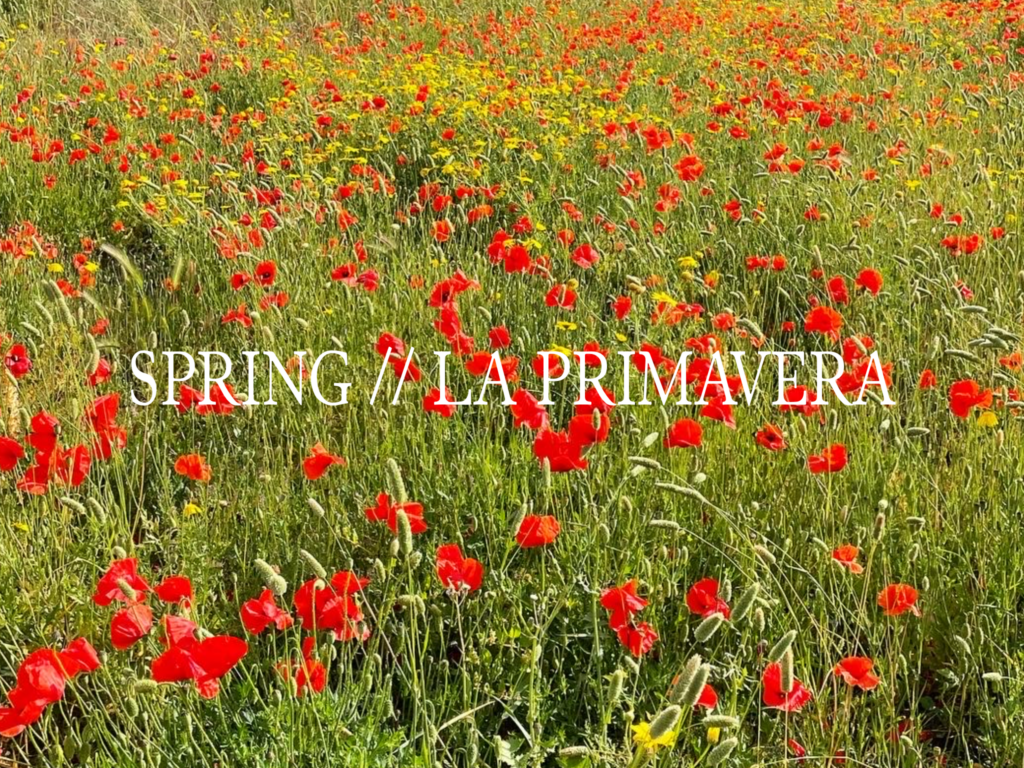
This is part of a series for the year inspired by Vivaldi’s Four Seasons and curated by Scott Noriega. You can listen to the playlist by clicking the button above and read on for Scott’s insightful notes on the pieces. I would recommend pairing the Spring Playlist with a Cirò Bianco, a fresh, fruit-forward and floral white from Calabria.
By Scott Noriega
Scott is a pianist, writer and music teacher from Queens, NY where he currently resides. Having run the academic gamut of degrees – from Bachelors to Masters and finally PhD – he is currently living his life a bit more: writing poetry, searching out pianistic repertoire, baking pastries, composing new music, and traveling, all while exploring the world of cocktails, history and music weekly on Instagram @telling_cocktails.
Francesco Landini
(c. 1325, Fiesole – 1397, Florence)
Ecco La Primavera
If the winter months and its related music create sensations of frigidity, chilly breezes complete with heartbreaking melodies yearning for the warmth of the months ahead, spring is all about renewal – the colorful blossoming of flowers dotting the landscape, the return of birds singing as they soar through the skies above, and the feeling of newfound warmth that sunny days and young love bring.
What better music to herald the season’s arrival than Francesco Landini’s Ecco La Primavera – Behold the Springtime – one of his loveliest secular ballatas written at the height of Italy’s Trecento, in the middle 1300s. Landini (if that was indeed his last name, we are unsure) was one of the leading Italian composers, poets, and organists living in the era. His musical talents were prodigious, made even more impressive as he was blinded in childhood, likely by a smallpox infection, but became renowned for his many musical talents: not just as a composer but equally as an organist and instrument builder.
Though he spent much of his time working for religious institutions as a composer he is known entirely for his secular output, particularly his ballate, many of which appear in the Squarcialupi Codex, a stunning illuminated manuscript collection of works compiled in the early 1400s, once owned by the Italian organist for whom it is named, Antonio Squarcialupi. That manuscript is now housed in the Biblioteca Medicea Laurenziana in Florence and contains 146 of his works – an impressive number as there are 216 works in the collection.
You’ll note that there are multiple performances of the work to listen to here. Why? As there is so little that we truly know about how this music may have been performed – which singers, how many of them, which instruments may have accompanied these singers, if any, and what of a fully instrumental performance? I say – why not all when the music is this gorgeous!
Ecco la primavera,
Che’l cor fa rallegrare,
Temp’è d’annamorare
E star con lieta cera.
Noi vegiam l’aria e’l tempo
Che pur chiam’ allegrezza
In questo vago tempo
Ogni cosa vaghezza.
L’erbe con gran freschezza
E fior’ coprono i prati,
E gli albori adornati
Sono in simil manera.
Behold the springtime,
Which makes the heart rejoice,
It is the season for love
And to gather together joyfully.
The air and the season, we note,
Both create happiness.
At this lovely time,
Everything becomes beautiful.
The grass with its great freshness
And the flower-covered fields,
And the trees, all adorned,
All share a common fashion.
Pietro Mascagni
(1863, Livorno – 1945, Rome)
Intermezzo from Cavalleria rusticana
Some composers become famous for a small number of works even though they produce quality compositions throughout their entire careers. Such is the case with Pietro Mascagni and his Cavalleria rusticana, which many consider to be among the very first Verismo operas – verismo referring to the sense of realism or truth in subject matter rather than the more mythological or historical-based dramas that were more commonly produced in the nineteenth century.
Among the composer’s earliest operas, written when he was just around 26 years old, Cavalleria contains some of the most gorgeous music written in the late years of the century. Set in a Sicilian village, the story follows Turiddu, who begins an affair with the married Lola after being rejected by his former lover, Santuzza. When Santuzza reveals the relationship to Lola’s husband, Alfio, the dishonored husband challenges Turiddu to a duel. The outcome is pure tragedy.
The Intermezzo is played as the curtain is up, with the scene showing the empty village square on Easter Sunday. The tune one hears is based on a church hymn heard earlier in the opera, the music creating a sense of rustic peacefulness, the simplicity of country life, as well as foreshadowing the intensity of the moment before the final tragedy ensues – just listen to those string tremolos and try not to swoon!
Ludovico Einaudi
(1955, Turin – )
Primavera
Ludovico Einaudi is best known as a composer of ambient, pop-influenced music that has now become a global phenomenon. If his music sounds nothing like the composers that he has studied under – he considers his most important teacher at the Milan Conservatory the avant-gardist Luciano Berio – he did take away something important from his time studying: keep an open mind to everything that comes your way.
Perhaps you remember the video that went viral years ago of him playing his composition Elegy for the Arctic on a floating platform in the Arctic Ocean off the coast of Svalbard, Norway in conjunction with Greenpeace. The point of this performance? To raise awareness on the fragility and elegance of the Northern regions, ones thought of, too often, simply as frozen deserts, but ones filled with natural beauty and tremendous life.
His Primavera for me is filled with springtime feelings: a tender yearning, even hopeful melody on the piano starting with a simple broken-chord sequence and accompanied by lush strings slowly grows into a bustling and animated middle section before it pulls back in on itself at the work’s mysterious and fragmented ending. Does it end or simply fade away like the season itself…
Vincenzo Bellini
(1801, Catania – 1835, Puteaux)
Casta Diva from Norma
If I had to describe the music of Vincenzo Bellini using a single term it would have to be the one that best describes Italian opera of the age, a style of which he was an absolute master: bel canto or beautiful singing, a type of music that evokes not only technical mastery and vocal agility but fluidity as well as tonal beauty. One thinks not only of Bellini here, but Donizetti and Rossini as well.
With just a gentle rocking back and forth in the orchestral accompaniment Casta Diva here evokes the springtime for me – the gentleness of the season’s breezes, the warmth of the harmonies, as well as the airiness of the flutes and eventually that of the singer, here Norma, the high druid priestess, who enjoys the peacefulness of the moment before the turmoil brought about by the tragedy of this story.
She here sings a prayer for peace in these oppressive times, when the Romans have conquered and taken over the Celtic lands. Norma beseeches the druid moon goddess to soothe the rage of her occupied people – at the same time that she is having a secret love affair with the unfaithful Roman proconsul Pollione who has fallen in love with another druid priestess, Adalgisa.
How do things end?
Let’s just say the final immolation scene features not just one but two major characters…
Baldassare Galuppi
(1706, Burano – 1785, Venice)
Keyboard Sonata in C Major
Baldassare Galuppi composed just under 100 keyboard sonatas between the years 1740 and 1770. They are among the most charming works written for the instrument that I know from the era – even including those by Haydn and Mozart. There is a refined vocal elegance and naturalness to the melodies, a simplicity of broken-chordal accompaniment, and a lighthearted jollity in the faster movements. Some might describe this music as naïve, but I would say that it is filled with childlike wonder.
Like many of the previous works, the C-Major Sonata begins with a simple broken-chord pattern. Here a lovely melody sits atop this cushion of sound, almost floating above it like butterflies in the wind. It evokes the feelings of springtime with its freshness, its airiness, and its gentle undulations – like the first cool breeze of spring after the long winter has come to its end.
Notice, also, how the movements become more animated as they proceed; the gentleness and peacefulness of the opening become filled with jollity and bubbliness. Life has returned to the land after the frigidity of the previous season and one can hear the tweeting and trilling of birds in the air…
Gioachino Rossini
(1792, Pesaro – 1868, Passy)
Overture to La Gazza Ladra
Speaking of birdcalls and bubbly music, there’s hardly a work I can think of that better dramatizes the ebullience of spring’s renewal than Rossini’s semi-serious opera (opera semiseria) La Gazza Ladra, in English, The Thieving Magpie.
Premiering at the Teatro alla Scala in Milan in 1817, it tells the story of a young servant girl, Ninetta, who is falsely accused of stealing a silver spoon from her employer. As suspicion grows, she is arrested and sentenced to death for her crime. Her father, who has secretly returned home after deserting his post in the army, attempts to save her. Luckily, and at the last moment before her execution is to take place, the truth is revealed: it is not Ninetta who has stolen the spoon, but the thieving magpie, a bird who has taken a plethora of shiny objects and hidden them in its nest. Once the spoon is found there, she is cleared of any crime and exonerated.
And for its lively overture: surely you can hear the devilish thieving magpie at the very beginning: those ever-present snare drums!
Ottorino Respighi
(1879, Bologna – 1936, Rome)
Primavera from Three Botticelli Pictures
Respighi’s Primavera is the very first of his Three Botticelli Pictures, each based on a painting by the artist, Sandro Botticelli. It now hangs in Florence’s Uffizi Gallery.
The painting portrays a number of important characters: on the far right is Zephyrus, the blue-skinned wind god who chases the nymph Chloris; Flora stands beside them, scattering flower petals across the ground; Venus, the Roman goddess of beauty, fertility, and sexuality calmly stands in the middle of the garden as a symbol of harmony and love while above her, the winged Cupid aims his arrow towards the Three Graces, who are elegantly dancing in a circle; Mercury, on the left, uses his staff to part the clouds, allowing the sunshine into the garden and helping to maintain the eternal spring.
Respighi seems not to focus musically on the individual characters in the painting, but rather the feelings that come with spring’s renewal. His instrumentation takes full advantage of the colors of the orchestra bringing these feelings to life.
His wife Elsa’s escription of the work perfectly sums up these joyful qualities: “Spring is personified by the figure of a woman. She comes forward scattering flowers, while all Nature ‘round about her awakes. Young women, wreathed with flowers, weave dances, the birds sing. Trills, songs and dances follow each other in the orchestra with rhythms of joy.”
Luca Marenzio
(c. 1553, Coccaglio – 1599, Rome)
Leggiadrissima eterna Primavera
Composed in 1591, over 300 years before Respighi’s colorful orchestral showpiece, is Marenzio’s fabulous and equally colorful madrigal – a work written for six solo voices singing a cappella – Leggiadrissima eterna Primavera (Most Graceful Eternal Spring).
Writing in the late Renaissance madrigal tradition, Marenzio combined expressive harmony, intricate vocal writing, and vivid word painting, a technique in which the music directly reflects the meaning of the text: ascending lines for rising or joyful imagery, biting dissonances for pain or sorrow, and fluid, moving lines for words such as stream, wind, or blossoming flower. His harmonies often explore chromaticism – coming from the Greek chromos or color – which adds emotional depth and subtle tension, building on the already expressive palette of earlier composers.
Just take a listen to some of the word painting here right near the beginning: on the words Vive scherzand’ à questi colli intorno (lives playfully around these hills) as the little six-note figures – four short followed by two longer notes – bounce between the voices starting around 25” on the word vive. The musical patterns dart back and forth between the voices as if going up and down the hills themselves.
Spring has not only sprung…it springs eternally!!
Domenico Scarlatti
(1685, Naples – 1757, Madrid)
Sonata in A Major, K. 322
Scarlatti wrote almost 600 keyboard sonatas in his lifetime. And each one of them is a gem in my book.
But there is something about this little A-Major Sonata as performed by the renown Italian pianist Arturo Benedetti Michelangeli that just feels perfectly springlike in its simplicity, the way he makes the very first note pop, ringing like an early morning church bell, the lightheartedness he brings to the faster moving notes, and the way he makes every little trill and ornament sparkle.
Giuseppe Martucci
(1856, Capua – 1909, Naples)
Serenata, op. 57 no. 2
Unusual for most Italian composers of the later nineteenth century, Giuseppe Martucci composed no operas. But an opera lover he was, promoting the music of Rossini, Verdi, and Wagner throughout his lifetime. He also worked to introduce the orchestral and chamber works of Brahms to Italy, music that became so much a part of him that was often labeled the “Italian Brahms.”
As a composer, he wrote many works for solo piano, orchestra, and chamber forces which helped to revitalize Italian instrumental music in his era. His influence on the next generation of modernist Italian composers was monumental in this way.
Originally composed for solo piano, Martucci himself transcribed this little Serenata for string orchestra in I may be a pianist myself – and don’t tell anyone! – but I much prefer this version with its gorgeous, sustained string sounds, its undulating orchestral accompaniment, and the warm melodic lines. These all seem to maintain the intimate mood and charm of the original piece while lending depth and gravity to the whole.
Antonio Vivaldi
(1678, Venice – 1741, Vienna)
Violin Concerto in E Major
The final Winter Concerto from Antonio Vivaldi’s Le quattro stagioni (The Four Seasons) began our lastseasonal journey, but here I’ve saved his equally magnificent E-Major Spring Concerto for now. As they say: Good things are worth waiting for!
The charm of this work, as with all the concertos in the collection, lies in part with Vivaldi’s original sonnetthat accompanies it – never forgetting the brilliant music itself!
And just as Vivaldi vividly paints the cold, harsh, biting winds in the last concerto, so too does he work hismagic here: from the fluid streams, the mellifluous birdsongs, the treacherous lightning and thunder of theseason’s storms, as well as the simple joy that the season brings, Vivaldi gives us an instrumental operain just about 10 minutes!
Allegro
Giunt’ è la Primavera e festosetti
La Salutan gl’ Augei con lieto canto,
E i fonti allo Spirar de’ Zeffiretti
Con dolce mormorio Scorrono intanto:
Vengon’ coprendo l’ aer di nero amanto
E Lampi, e tuoni ad annuntiarla eletti
Indi tacendo questi, gl’ Augelletti;
Tornan’ di nuovo al lor canoro incanto:
Largo
E quindi sul fiorito ameno prato
Al caro mormorio di fronde e piante
Dorme ‘l Caprar col fido can’ à lato.
Allegro
Di pastoral Zampogna al suon festante
Danzan Ninfe e Pastor nel tetto amato
Di primavera all’ apparir brillante.
Quickly
Spring has festively arrived
Welcomed by birds with joyous songs,
And the streams, amid gentle breezes,
Whisper softly as they sink.
The sky is covered in black and
Thunder and lightning announce the storm.
When they go silent, the birds
Resume their charming songs.
Slowly, Broadly
And in the pleasant flowery meadow,
To the soft murmur of leaves and plants,
The goatherd sleeps, his faithful dog by his side.
Quickly
To the happy sound of a rustic bagpipe,
Nymphs and shepherds lightly dance
As spring appears in all its glory
Giovanni Paisiello
(1740, Taranto – 1816, Naples)
Già riede primavera from Il barbiere di Siviglia
When one sees The Barber of Seville, one assumes that they will be hearing the music of Gioachino Rossini. It is his Barbiere that has become world famous – even Bugs Bunny sings the Largo al factotum from Rossini’s opera in the Warner Bros. production The Rabbit of Seville (1950).
But long before Rossini’s 1816 version came around, Giovanni Paisiello set the text in his own extremely popular setting in 1782, some 34 years before Rossini. In fact, when Rossini’s opera premiered in Rome it was, mildly put, a disaster: singers tumbled on stage, instrumental strings broke at important moments, the orchestra seemed under-rehearsed for some of their challenging parts, all while Paisiello fans booed the entire evening.
Worry not though – the second performance was more successful, with most everything shifting in favor of Rossini. Even the Paisiello fans seemed to warm to the flashier more modern musical setting.
So why choose Paisiello here over Rossini? Because if one has never heard his version – and that’s a lot of people! – then one may very well be surprised at not only the quality of his writing, but the charm of the entire musical setting.
Paisiello’s Barbiere is truly magnificent! Just listen to how Rosina sings not just of the joys of spring’s blossoming – Già riede primavera col suo fiorito aspetto – but also of the pain that she feels for lost love: Io piango afflitta, e sola, misera pastorella.
Gian Carlo Menotti
(1911, Cadegliano-Viconago – 2007, Monaco)
Barcarolle from Sebastian
Though far better known for his operas such as The Medium (1946), The Consul (1950) or the very first television opera of all time Amahl and the Night Visitors (1951) Gian Carlo Menotti was interested in any and every form of dramatic music – he here produced one of the most gorgeous ballets of the mid twentieth century.
Though I’ve never seen the work on stage – I’m not sure how often it has been there since its inception – I can only imagine how the dancers might move to the modernist Street Fight, glide to the lyrical Pavane, or perhaps swoon to the most gorgeous of any work in this ballet, at least in my book – the Barcarolle or Boat Song, a perfect genre for a work set in the city of Venice.
Can any music glide you into spring better than this joyous gem? I think not!
Giuseppe Verdi
(1813, Le Roncole -1901, Milan)
Prelude and Brindisi from La Traviata
Which brings us, once again, to the final leg of our musical journey.
And where better to leave off than with two numbers from Verdi’s 1853 masterpiece La Traviata, the magical Prelude that opens the work, setting the mood and time – it must be spring! – and the charming Brindisi or drinking song that begins with Alfredo’s simple words: Libiamo ne’ lieti calici – Let us drink from the joyful cups!
Verdi’s story centers on Violetta, a courtesan living in Paris who contemplates escaping the only life she knows for true love with Alfredo before her fatal illness consumes her. But will she allow love to blossom, or will time expire before that happens?
Perhaps the best lesson we can learn from her tale is that true love can be found everywhere we look, perhaps especially in those places that seem most impossible.